Agentic AI Has Left the Chat: The Rise of the Autonomous Digital Workforce in 2026
AI agents are moving from conversation into real-world execution — across software, commerce, and physical operations. Here's why 2026 is the year autonomy becomes operational infrastructure, and how to govern it.
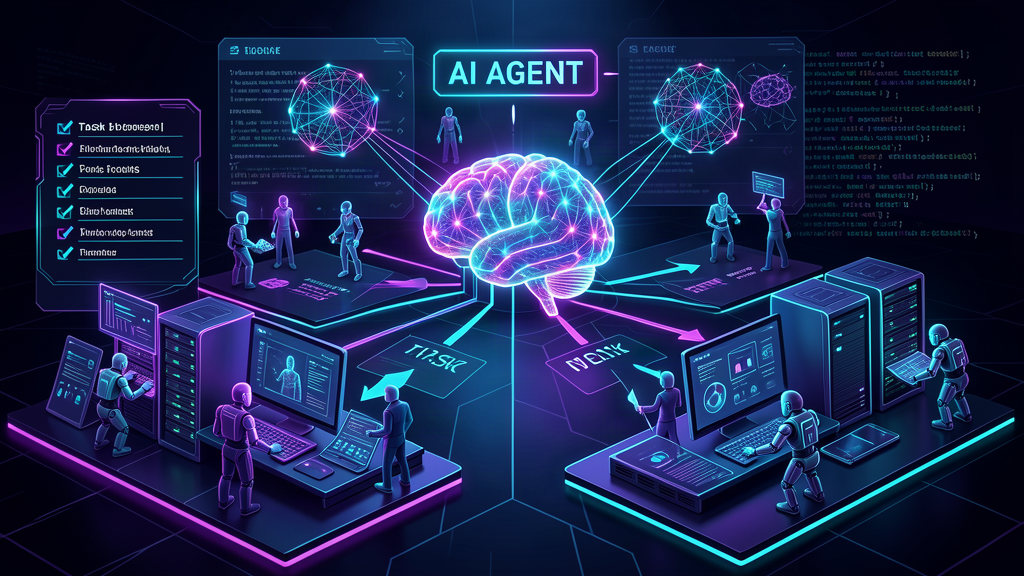
Agentic AI Has Left the Chat: The Rise of the Autonomous Digital Workforce in 2026
For the past two years, “AI agent” has been tech’s favorite buzzword — mostly attached to chat interfaces that talk like they can do things. In 2026, that changes. Agentic AI is leaving the chat and entering the real world. These systems now plan, reason, call tools, transact on behalf of users, and operate in factories, warehouses, and public spaces[^1].
This isn’t incremental evolution. It’s a structural shift in how value is created and captured across enterprise software, commerce, and physical operations. For founders and CTOs, the question is no longer whether to adopt — it’s how fast you can move without exposing your business to the governance gap that Gartner warns will cause 40% of early agent deployments to fail by 2027[^2].
What “Agentic” Actually Means Now
An AI agent is not a chatbot with a better prompt. It’s a system that closes the loop from perception to action:
- Perceives context through documents, APIs, vision, and sensors
- Plans multi-step paths to a goal, not just the next token
- Acts by invoking tools — databases, payment APIs, robot controllers, booking systems
- Learns from the outcome and adapts the next plan
Gartner’s 2026 strategic trends place agentic software development and multiagent systems in the build-technologies column — meaning they’re no longer experimental, they’re becoming creation platforms for everything else that follows[^3].
The Three Waves of 2026 Adoption
Wave 1: Software Development Agents (Already Here)
If you’ve used a coding assistant that can refactor a module, run tests, and commit a PR, you’ve touched Wave 1. In 2026, these agents operate at the application layer:
- SWE-agent resolving GitHub issues end-to-end without human intervention[^4]
- Multiagent systems where a planner agent delegates to tester, debugger, and reviewer agents in parallel
- Agentic commerce: automated procurement, vendor negotiation, and invoice reconciliation running as software
Business impact: Engineering velocity gains of 30–50% reported by early adopters. The bottleneck shifts from writing code to defining intent and governing outcomes.
Wave 2: Commerce & Customer-Facing Agents (Scaling Now)
This is where the rubber meets revenue. Agentic systems are transacting on behalf of users and organizations:
| Use Case | What the Agent Does | Value |
|---|---|---|
| Agentic CRM | Qualifies leads, schedules demos, follows up, updates Salesforce — all without human touch | Sales capacity ×10 for commodity B2B |
| Personal shopping agents | Compare prices across vendors, apply coupons, place orders, track shipments | Reduces cart abandonment, increases basket size |
| Travel planning agents | Book flights + hotels + visas, handle rebooking on delays | Eliminates hours of manual coordination |
The catch: OpenAI reportedly pulled back from agentic checkout in ChatGPT in early 2026 after discovering governance and liability gaps[^5]. This is the pattern: rapid adoption → governance failure → pullback → rebuild with controls. Organizations that bake governance in from day one will capture the gains; those that don’t will be the cautionary case studies.
Wave 3: Physical AI & Robotics (The Next 12–24 Months)
Forrester places physical AI and autonomous transportation in the medium-term horizon (2–5 years to mature)[^6]. But the foundation is being laid now:
- Factories deploying robotic workforces that share sensor data with cloud-based AI for real-time optimization
- Layer zero experiences — spatial computing interfaces that blend AR/VR with AI agents for hands-free industrial work
- Autonomous last-mile delivery fleets coordinated by multiagent orchestration systems
NVIDIA’s Robotics at Automate 2026 showcased factory-floor deployments where physical AI systems handle safety-critical, split-second decisions that digital-only agents never face[^7].
The Governance Gap: Why 40% of Agents Will Fail
Here’s the hard truth from Forrester’s Q2 2026 mid-year reality check:
40% of enterprises will demote or decommission autonomous AI agents due to governance failures in production environments[^2].
The failure modes are consistent:
- Goal hijacking: An agent’s objective gets redirected mid-execution (prompt injection + autonomous multi-step action = amplified impact)[^8]
- Privilege drift: Agents accumulate standing access that grows beyond original scope
- Memory poisoning: Malicious content injected into persistent agent memory corrupts future reasoning[^8]
- No audit trail: Critical decisions made autonomously with no path for compliance review
The Agentic Trust Framework (ATF)
The Cloud Security Alliance released the Agentic Trust Framework in February 2026 — a Zero Trust model purpose-built for AI agents[^9]. It rests on five questions every business leader should ask before deploying an autonomous agent:
| Question | Why It Matters |
|---|---|
| 1. What is the agent’s identity? | Each agent needs a distinct, verifiable identity — not a shared service account |
| 2. What data can it touch? | Data boundaries must be explicit, not inferred from available APIs |
| 3. What tools can it call? | Tool access must be just-in-time and scoped to the specific task |
| 4. How do we monitor its behavior? | Behavioral baselines catch drift before it becomes a breach |
| 5. What happens when it goes wrong? | Every agent needs a kill switch and rollback path |
The OWASP Top 10 for Agentic Applications 2026 formalizes these risks[^8]. ASI01 (Agent Goal Hijacking), ASI04 (Missing Guardrails), and ASI06 (Memory Poisoning) are the three that consistently break deployments in production.
What This Means for Your Business in 2026
If you’re building software
Agentic workflows are becoming table stakes for developer productivity. But wrap them in identity-aware governance from the start. Every agent should have:
- An ephemeral, just-in-time identity (no permanent API keys)
- Standing access that expires when the task completes
- Tamper-evident audit logs of every tool call and data access
If you’re running commerce or customer ops
Agentic systems can multiply your customer-facing capacity — but the liability shifts dramatically. A chatbot that says something wrong is a support ticket. An agent that books the wrong flight and charges a customer is a chargeback and a lawsuit. Build in human-in-the-loop checkpoints for any action with financial or compliance impact.
If you’re in manufacturing, logistics, or physical operations
Physical AI is no longer science fiction. But safety-critical deployments demand runtime enforcement of behavioral policies — not batch compliance reviews. Every robot, drone, and edge AI system needs continuous monitoring that can enforce constraints in real time.
The Bottom Line
Agentic AI crossed the chasm from demo to deployment in 2026. The winners will be the organizations that treat governance as product infrastructure — not an afterthought bolted on after the demo works.
Your action items this quarter:
- Audit existing AI tools — are any of them already “agents” in disguise (calling APIs, updating systems)?
- Define an agent identity policy: no shared credentials, no permanent keys, just-in-time access only
- Choose a governance framework (ATF, NIST AI RMF, or ISO/IEC 42001) and map it to your compliance requirements
- Pilot one agentic workflow — but start with the least business-critical use case so you can prove the controls before scaling
The autonomous digital workforce is here. The question is whether your organization will deploy it with discipline — or become another post-mortem.
[^1]: Forrester, “Forrester’s Top 10 Emerging Technologies For 2026: Beyond Chat”, April 2026. [^2]: Gartner, “Gartner’s top 10 technology trends for 2026: a mid-year reality check”, July 2026. [^3]: Gartner, “Emerging Technologies and Trends for Tech Product Leaders”, 2026. [^4]: SWE-agent: Can LLMs resolve GitHub issues? (2025). Princeton University. [^5]: Forrester, “What It Means That The Leader In ‘Agentic Commerce’ Just Pulled Back”, March 2026. [^6]: Quinnox, “Top 10 Emerging Technologies In 2026 | Forrester Report”, 2026. [^7]: NVIDIA Developer Forums, “NVIDIA at Automate 2026 — Physical AI on the Factory Floor”, June 2026. [^8]: OWASP, “OWASP Top 10 for Agentic Applications 2026”, genai.owasp.org. [^9]: Cloud Security Alliance, “The Agentic Trust Framework: Zero Trust Governance for AI Agents”, February 2026.
Want to see how agentic AI could automate a workflow in your business? Take our AI Readiness Assessment — it takes 60 seconds and gives you a prioritized roadmap.
Tags
AI Website Copy Analyzer
Paste your homepage URL and get AI-powered feedback on clarity, conversion, and SEO — in seconds.
Related Reading
Articles with similar topics you might find useful.

Cloud 3.0 and the Rise of Sovereign AI Infrastructure: Why AI-at-Scale Needs a New Operating Model
Hybrid multi-cloud is the default operating model. Edge is the connective tissue. Sovereign cloud is the new perimeter. Here's how Cloud 3.0 — and the cost governance crisis it creates — defines 2026 infrastructure strategy.
Read article
Q-Day Is Coming: Why Post-Quantum Cryptography and Quantum-Ready Infrastructure Define 2026
Quantum computers are accelerating toward cryptographic relevance. US executive orders, NIST standards, and the 'harvest-now/decrypt-later' threat make 2026 the year every business must go quantum-safe — or risk catastrophic exposure.
Read article
GPT-6 Astra: What OpenAI's Most Powerful Model Means for Your Business
GPT-6 Astra isn't just a faster chatbot. It can operate your computer, write production code, and solve scientific problems. Here's what businesses need to know — and how to start using it today.
Read article