Q-Day Is Coming: Why Post-Quantum Cryptography and Quantum-Ready Infrastructure Define 2026
Quantum computers are accelerating toward cryptographic relevance. US executive orders, NIST standards, and the 'harvest-now/decrypt-later' threat make 2026 the year every business must go quantum-safe — or risk catastrophic exposure.
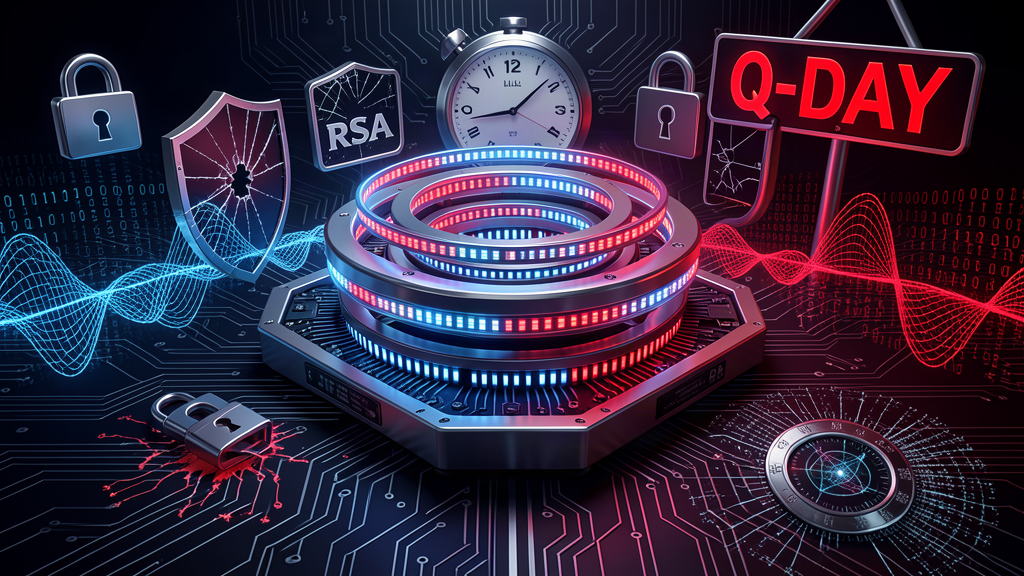
Q-Day Is Coming: Why Post-Quantum Cryptography and Quantum-Ready Infrastructure Define 2026
On June 22, 2026, the White House signed two executive orders that should have sent a shiver down every CTO’s spine:
- “Ushering in the Next Frontier of Quantum Innovation” — a whole-of-government push to deploy a scientifically useful quantum computer
- “Securing the Nation Against Advanced Cryptographic Attacks” — a directive to federal agencies to accelerate adoption of post-quantum cryptography (PQC)
This wasn’t theoretical planning. It was emergency preparedness. Because Q-Day — the point when quantum computers can break today’s public-key encryption — is no longer a distant horizon. It is a near-term, high-stakes deadline that demands action now.
For businesses, the threat is twofold: today’s encrypted data is being stolen today to be decrypted tomorrow, and tomorrow’s quantum computers will render all current PKI, TLS, and identity systems obsolete.
This is the year quantum readiness shifts from boardroom buzzword to infrastructure imperative.
What Is Q-Day (And Why It’s Not Tomorrow Anymore)
Q-Day is the cryptographic milestone where a sufficiently powerful quantum computer can break the RSA and elliptic-curve cryptography that secures:
- Every HTTPS connection on your website
- Every credit card transaction
- Every SSH login to your servers
- Every digital signature on contracts and code
- Every encrypted backup in your cloud storage
The Timeline Is Accelerating
| Authority | 2024 Estimate | 2026 Assessment | 2026 Executive Order |
|---|---|---|---|
| Academic consensus | “2030s or later” | “Plausible risk by 2030” | Federal agencies must migrate now |
| Cloudflare | Monitoring quantum threat | 65% of traffic already post-quantum encrypted | Targeting 2029 for full post-quantum security |
| Cloud Security Alliance | Research phase | “Inflection point” reached | Recommends immediate crypto-agility |
The CSA’s March 2026 report explicitly states: Forrester assessed practical quantum utility as feasible within five years and characterized Q-Day as a plausible risk by 2030[^1]. But “by 2030” is not “after 2030” — and the migration takes years.
Why It’s Urgent Even If Q-Day Is Years Away
Harvest now, decrypt later: Adversaries are already intercepting and storing encrypted traffic — VPN sessions, API calls, customer databases, SSH keys — because they know that once a quantum computer exists, all of today’s “secure” communications will be instantly readable[^2].
The harvest-now/decrypt-later attack:
Encrypted data stolen today → stored in adversary archives → decrypted when Q-Day arrives → all "secure" communications fully exposed
This means every piece of sensitive data you transmit today is already at risk. A customer database encrypted with RSA-2048 in 2026 will be readable by anyone with a quantum computer in 2030 — including state actors who intercepted it in 2026 and waited.
The Quantum Threat, By Use Case
1. Website Security & TLS Certificates
Every website using RSA or ECC certificates is vulnerable. When Q-Day arrives, a malicious actor with a quantum computer can:
- Forge your SSL certificate and impersonate your site
- Intercept all customer communications
- Sign malicious code as if it were from your organization
Real-world impact: A fintech’s customer portal could be silently compromised. Users would see the green lock icon but be talking to an attacker who can read every keystroke, every transaction, every session token.
2026 reality: Cloudflare reports 65% of human traffic to their network is already post-quantum encrypted — but authentication (the harder problem) still needs upgrading[^3].
2. Code Signing & Software Supply Chain
Every software update you push is signed with keys that quantum computers will eventually break. A quantum-capable attacker could:
- Forge software updates for your application
- Compromise your CI/CD pipeline retroactively
- Inject backdoors into software that was “securely” signed years ago
The SolarWinds attack showed how devastating supply chain compromise can be. Q-Day makes it systematically easier.
3. VPN & Remote Access
Corporate VPNs, SSH access, and remote desktop protocols all rely on cryptographic handshakes that quantum computers will break. Every employee working remotely today is potentially exposing corporate secrets that will be decrypted in the future.
4. Encrypted Backups & Long-Term Storage
If you have encrypted backups, customer data stores, or compliance archives secured with current cryptography, they are already compromised — assuming the attacker has been harvesting them.
Post-Quantum Cryptography: The NIST Standards That Matter
After years of selection, NIST finalized three post-quantum cryptographic standards:
CRYSTALS-Kyber (Key Encapsulation)
- Replaces RSA/ECC for key exchange in TLS
- Status: FIPS 140-3 certified, production-ready
- Action: Your TLS certificates need to support hybrid Kyber+ECC during migration
CRYSTALS-Dilithium (Digital Signatures)
- Replaces RSA/ECC signatures for code signing, document signing
- Status: FIPS 140-3 certified, production-ready
- Action: Plan to re-sign all software, certificates, and credentials
FALCON (Digital Signatures, lattice-based)
- Compact signatures, alternative to Dilithium
- Status: Standardized, implementations maturing
- Use case: Where signature size matters (IoT devices, firmware)
The Migration Is Already Starting
| Timeline | Milestone |
|---|---|
| 2024–2025 | Algorithm selection, vendor evaluation |
| 2026 | Hybrid deployment begins — systems run PQC alongside classical crypto |
| 2027–2028 | Full PQC migration for critical systems |
| 2029+ | Classical crypto deprecation |
The Five-Phase Quantum-Ready Migration Plan
Phase 1: Inventory & Risk Assessment (Q3 2026)
Action items:
- Map every system that uses public-key cryptography: TLS certs, SSH keys, code signing, VPN, email PGP, database encryption
- Identify which systems protect long-lived sensitive data (data that needs to stay confidential for 10+ years)
- Score each system by exposure risk (high/medium/low) based on data sensitivity and quantum-readiness timeline
Tool: Create a cryptographic asset inventory. For each system, record: algorithm, key size, certificate expiry, data sensitivity, and compliance requirements.
Phase 2: Crypto-Agility Framework (Q4 2026)
Action items:
- Implement hybrid cryptography where PQC algorithms run alongside classical ones
- Upgrade to TLS 1.3 with hybrid Kyber+ECC key exchange
- Establish a cryptographic configuration management process — no more hardcoded crypto, all configurable
Key insight: You don’t need to rip and replace. You need to run both in parallel, then gradually shift the priority.
Phase 3: Certificate & Credential Reissuance (2027)
Action items:
- Reissue all TLS certificates with hybrid Kyber+ECC support
- Re-sign all software, firmware, and code artifacts
- Rotate all SSH keys and long-lived credentials
- Update PKI infrastructure to issue PQC-capable certificates
Phase 4: Identity & Authentication Upgrade (2027–2028)
Action items:
- Migrate authentication systems to post-quantum identity protocols
- Update MFA/2FA systems that rely on cryptographic challenge-response
- Re-enroll all hardware security modules (HSMs) with PQC support
Warning: Authentication is the hardest part — Cloudflare’s 2029 target is for encryption; authentication will take longer[^3].
Phase 5: Deprecation & Monitoring (2028+)
Action items:
- Monitor for quantum computer breakthroughs with real-time alerting
- Begin deprecating classical-only crypto paths
- Maintain crypto-agility for the next transition (because quantum won’t be the last)
Real Costs: What This Will Actually Cost You
| Component | 2026 Cost Estimate | Notes |
|---|---|---|
| PQC library licensing (Kyber/Dilithium) | $0 – $50K/year | OpenSSL 3.0+ includes free PQC; commercial support costs |
| TLS certificate reissuance | $5K – $50K | Depends on cert volume and CA support |
| Code signing infrastructure | $20K – $100K | New HSMs, signing pipeline updates |
| Identity system upgrade | $100K – $500K+ | Enterprise SSO, MFA, and PKI overhaul |
| Vendor assessment & migration | $50K – $200K | Third-party integrations, API compatibility |
Total first-year investment: $175K – $900K for a mid-market enterprise.
But the cost of inaction? A single successful quantum attack on your encrypted customer data = $millions in breach liability, regulatory fines, and brand destruction.
The Immediate Actions You Can Take in 2026
This Week
- Audit your cryptography inventory — what’s using RSA-2048, ECC P-256, or older algorithms?
- Check your threat model — does your data need to be confidential for 5+ years? If so, it’s already at risk.
- Engage your certificate authority and security vendors — ask about their PQC roadmap and timeline.
This Quarter
- Deploy OpenSSL 3.0+ with PQC support in staging environments
- Run a proof-of-concept with hybrid Kyber+ECC TLS on a non-production system
- Update your incident response plan — add quantum breakthrough scenarios with specific triggers
This Year
- Establish crypto-agility as a principle — make cryptographic algorithms configurable, not hardcoded
- Budget for the multi-year migration — this is not a one-time project; it’s a 3-year program
- Train your security team on post-quantum cryptography and migration strategies
The Bottom Line
Q-Day is not coming in a distant future. It is the security equivalent of Y2K — a known deadline that requires systematic remediation across your entire infrastructure. The difference is: Y2K was about fixing date logic in legacy code. Q-Day is about replacing the mathematical foundation of all digital trust.
The executive orders signed in June 2026 were not precautionary. They were recognition that the threat is now real and the window for preparation is closing.
Every byte of sensitive data you transmit or store today is a potential liability tomorrow. The organizations that treat quantum readiness as business-critical infrastructure — not a research project — will survive Q-Day. The rest will become case studies in catastrophic unpreparedness.
[^1]: Cloud Security Alliance, “Q-Day Clock: Enterprise Post-Quantum Migration Imperative”, February 2026. [^2]: Palo Alto Networks, “What Is Q-Day? Quantum Computing and Cyber Risk”, 2026. [^3]: Cloudflare, “Cloudflare targets 2029 for full post-quantum security”, March 2026.
Need help assessing your organization’s quantum-readiness? Run our Website Cost Estimator to quantify the infrastructure investment needed — or contact us for a quantum risk assessment.
Tags
AI Website Copy Analyzer
Paste your homepage URL and get AI-powered feedback on clarity, conversion, and SEO — in seconds.
Related Reading
Articles with similar topics you might find useful.
Agentic AI Has Left the Chat: The Rise of the Autonomous Digital Workforce in 2026
AI agents are moving from conversation into real-world execution — across software, commerce, and physical operations. Here's why 2026 is the year autonomy becomes operational infrastructure, and how to govern it.
Read article
Cloud 3.0 and the Rise of Sovereign AI Infrastructure: Why AI-at-Scale Needs a New Operating Model
Hybrid multi-cloud is the default operating model. Edge is the connective tissue. Sovereign cloud is the new perimeter. Here's how Cloud 3.0 — and the cost governance crisis it creates — defines 2026 infrastructure strategy.
Read article